

NSFW AI Poses and Camera Angles: Where the Camera Stands Changes the Picture
By The Fellowi Team · · 7 min read
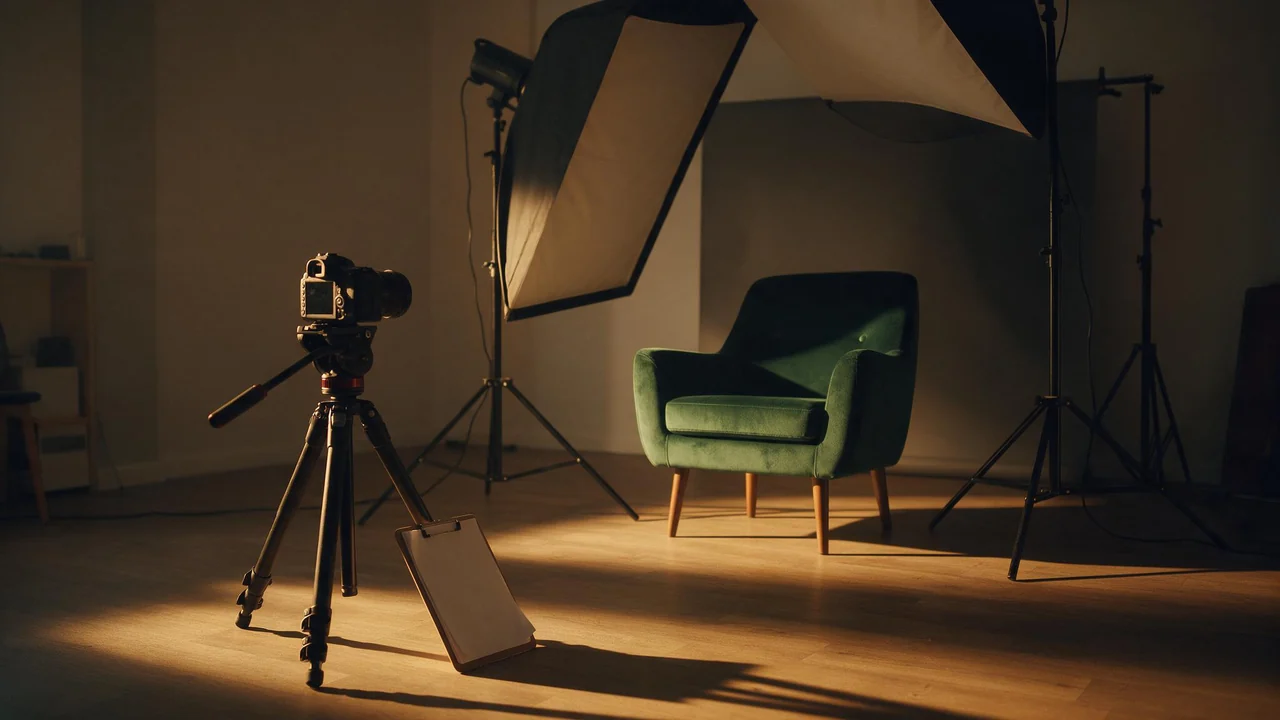
Two earlier posts covered light and fabric. This one covers what a photographer decides before either: where the camera stands. In character generation the camera is a sentence you write, and if you leave it out the model picks for you, usually a centred, eye-level, waist-up frame. Fine once. Dull by the tenth picture. What follows is a shot list, numbered the way it would be taped to a light stand.
1. Camera height
- Eye level.The honest default: intimate, conversational, nothing to decode. Write “eye-level shot”.
- Low angle.The camera below her face, looking up. Confidence, presence, a little drama. “Low-angle shot from below”.
- High angle. The camera above, looking down. Softer and quieter. Use it with care: from too high an adult can read smaller and younger than she is, so keep the adult cues in the description.
- Overhead.Straight down, for someone lying on a bed or a rug, when the fabric and the spread of hair are the picture. “Top-down overhead shot”.
2. Shot size
Say how much of her is in the frame, or the model crops as it likes. A close-up is face and shoulders, a medium shot is waist up, a three-quarter shot is mid-thigh up, a full figure is head to toe. Each one changes what the picture is about: a close-up is about expression, a full figure is about posture and the room around it.
3. Lens words
Lens names are photographers’ vocabulary, and image models respond to them. “85mm portrait lens, shallow depth of field” flattens the features and melts the room into blur. “35mm, environmental portrait” keeps the room in the story. “Wide angle” up close stretches whatever is nearest the camera, which is rarely kind to hands and legs. Name one lens, not three.
4. Poses that render, poses that break
- Usually render well: standing with the weight on one leg, sitting on the edge of a chair or a bed, lying on one side, looking back over a shoulder, leaning in a doorway.
- Often break: crossed arms and legs where limbs overlap, interlaced fingers, hands touching the face, contortions, any pose where one limb hides behind another.
The fix for hands is to give them a job: holding a cup, a sheet, the edge of a door, the strap of a bag. An occupied hand is a simpler shape than a free one. The usual failures and their cures are collected in the mistakes post.
5. Gaze
Looking into the lens speaks to the viewer; looking away makes the viewer a witness. Write it down: “looking directly at the camera” or “looking out of the window, unaware of the camera”. A gaze line costs a few words and changes the whole picture.
6. Match the frame to the pose
A standing full figure wants a tall frame, 2:3 or 4:5. A reclining figure wants a wide one, 16:9 or 3:2; fight that and the model either crops the feet or invents floor. 9:16 is for a story and suits a standing pose or a close-up. The aspect ratio guide covers the rest.
7. Keep her, change the camera
Once one picture is right, attach it as a reference and change only the camera and pose lines. The reference holds the face; a big change of pose can loosen the outfit, so expect a few re-rolls. The full routine is in keeping one character consistent. And a frame you love can move: Fellowi Video animates a still, as the image-to-video guide shows.
The lines that do not move
Everyone in the frame is a clearly adult person of legal age, and no angle, pose or styling is used to make an adult read as a child. A prompt that refers to a minor, in any way, is refused before a single coin moves. Age-play and non-consent are refused just the same, and no real person’s face belongs in the picture. The full version is in the legal guide.
What camera words cannot do
They steer; they do not measure. You cannot place a hand to the centimetre the way you can direct a model on set, and a reference image carries a look rather than a stance, so do not expect it to copy a pose from a photo. Hands and overlapping limbs remain the most common failure, the generator does not promise anatomically correct output, and some takes are simply re-rolls. Prices and quality levels are on the product page.
Try one change at a time in Fellowi Images: the same prompt at three camera heights, side by side. One of them will tell the story better than the others, and that is the habit worth keeping.
Questions this post answers
Which camera angle is the most flattering in AI portraits?
Eye level or slightly above, with a portrait lens such as 85mm, is the safe start, and a low angle adds presence. A wide-angle lens close up stretches whatever is nearest the camera.
Why do hands keep coming out wrong?
Overlapping fingers and free hands are among the hardest shapes for image models. Give the hands a job, such as holding a cup or a sheet, and keep them away from the face.
Can I copy a pose from a photo?
Not reliably. A reference image carries a face and a look rather than an exact stance, so describe the pose in words and re-roll, and only upload photos of yourself or of someone who gave permission.
Keep reading
NSFW AI Scenes and Settings: Dress the Room Before You Light It
Before the light, the outfit or the pose, there is a room. A set designer's walk through four dressed rooms, the props that earn their place, and the sentence that keeps a setting from drifting.
NSFW AI Boudoir Lighting: Five Recipes You Can Paste Into a Prompt
Light is the part of an intimate AI picture most people leave to chance. Five recipe cards, one sentence each, plus how to keep a whole set under the same light.
NSFW AI Fantasy Characters: Designing an Original Adult Elf, Vampire or Knight
An elf ranger, a vampire countess, a knight with a scar: original fantasy characters are where AI pictures get personal. A character sheet, the anchors that carry her, and the rules that hold.