

Jewelry and Accessories for Adult AI Character Art: A Stylist's Kit List
By The Fellowi Team · · 7 min read
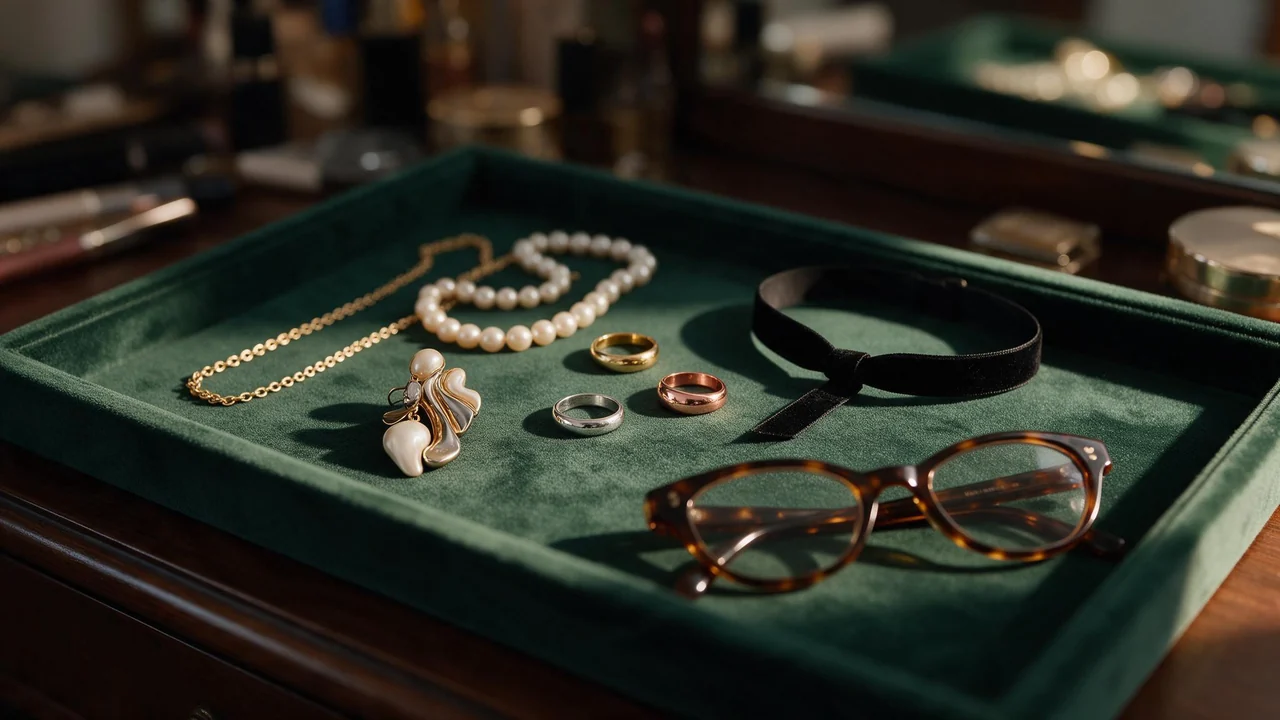
A stylist packs for options and dresses for restraint. Into the case goes everything: three chains, a pearl strand, a tray of rings, two pairs of glasses, gloves, a length of ribbon. Onto the character go one or two of them. The rest travels so that the right piece is within reach, not so that it gets worn.
That is the whole method for accessories in Fellowi Images. Small pieces finish an adult character portrait: they say where the evening is going, what the character can afford, whether they are careful or careless. They are also where image models are weakest, because they are small, they shine, and they often come in pairs. This kit list covers both halves: what to pack, and what goes wrong when the character wears too much of it.
Metal before pieces
Choose the metal before the piece. It is a colour decision, and it has to agree with the grade of the whole frame.
- Yellow gold lives in warm palettes: amber, honey, candlelight, warm skin. In a cold teal room it becomes the one warm point, which is a fine accent if you meant it.
- Silver and white goldbelong to cool and monochrome frames; in black and white, silver is simply light. Under a warm grade it tends to turn yellow, so write “bright polished silver” to keep it cold.
- Rose goldis the bridge: warm enough for amber, soft enough for pastel, kind to most skin. It drifts toward copper or plain gold, so write “pale rose gold”.
- Mixed metalsare a real look (“stacked rings in gold and silver”), but they read as a choice only when the prompt says so. Otherwise the model averages them into one.
Then name the finish: polished, brushed, hammered, antique. Metal is mostly reflection, so the light decides how it looks. One small hard source gives a sharp glint; a large soft one gives a quiet sheen. The grades this has to agree with are on the colour palette cards.
The kit list
Each entry: the words to write, what the piece says, and where it fails.
- A fine chain.“A single fine gold chain”, “a delicate chain with a small round pendant”. Says everyday, quiet, expensive without trying. Fails by melting into a neckline, a strap or the hair; the word “single” keeps it from becoming two.
- Pearls.“A single strand of pearls at the collarbone”, “small pearl stud earrings”. Classic and a little formal; with an oversized white shirt they turn playful. Beads come out uneven or fuse into a band, and a short strand renders better than a long rope.
- One statement earring.“A single sculptural gold earring, the other ear bare”. Editorial and sure of itself. Write the bare ear outright, or the model mirrors the earring onto the other side.
- Rings.“One thin gold band on the right ring finger”, “a signet ring on the little finger”, “a cocktail ring with a green stone”. A great deal of character for a small object. Name one ring and one finger.
- An anklet.“A thin gold anklet”. Summer, barefoot, a holiday. In a full-length frame it is a few pixels wide and vanishes, so it needs a frame that actually shows the ankle.
- A choker or a ribbon.“A black velvet ribbon choker”, “a satin ribbon tied at the neck”. A styling word, not a costume: one graphic line at the neck, at its best in monochrome. Over-describe it and it turns into a collar; one ribbon, one colour.
- Glasses.“Thin tortoiseshell glasses”, “round gold wire-frame glasses”. They change the whole read of a face: clever, off duty, amused. Lenses can flare or warp the eyes; “clear lenses, no glare” helps.
- Hair pieces.“A tortoiseshell claw clip”, “a single pearl hair pin”, “a silk scarf tied into the hair”. Write them with the hair, in the order the hair and makeup notes build a look.
- Gloves.“Black satin opera gloves”, “thin leather driving gloves”. Instant evening or instant period piece. Gloved hands lose fingers even more easily than bare ones, so keep them still.
- Stockings, as an accessory.“Sheer black stockings with a back seam” works as one styling line, not as an outfit. The words for how sheer fabric renders are in the fabric guide.
- A watch.“A slim vintage gold watch on a brown leather strap”. The one piece that says time and money on anyone. The dial tends to fill with invented numerals, so keep it small and turned slightly away.
Every character this kit dresses is an adult: minor-coded words and any stated age under eighteen are refused before any coin moves, and age-play and non-consent are refused the same way. The full rules are in what the law and our terms allow.
One or two, not a pile
The old stylist's rule is to dress the character and then take one thing off. In a prompt the rule is stronger than taste. Every accessory competes for the same few square centimetres around the face and hands, and with five pieces in play the model starts trading features between them: the earrings borrow the necklace's metal, the chain grows pearls, a bracelet appears that nobody packed.
So pick a lead piece and at most one support, and give each a place on the body. A piece with a location (“on her right hand”, “at the collarbone”) lands where you put it more often than a piece floating in a list. Write the accessories right after the clothes, before the light and the grade:
A woman in her forties with dark hair streaked with silver, in a black silk shirt open at the collar, one long gold drop earring with the other ear bare, a thin gold band on her right hand, warm lamp light, close portrait.
Note what is missing: no necklace, no bracelet, no watch. The earring is the sentence; the band is the full stop.
The signature piece
Accessories are the cheapest way to make a set of pictures feel like one person. Faces drift a little from render to render, and a recurring object reads as identity long before a viewer checks the jawline. Give the character one signature: the same signet ring, the same tortoiseshell glasses, the same red ribbon. Write it in exactly the same words in every prompt of the set.
Then attach your best picture as a reference image. A reference carries the face and the look across a set, and with the aspect ratio on Auto the frame follows the first reference. Small details are the last thing a reference holds, so a close crop where the piece is clearly visible works better than a wide shot. A photo of a piece you own can serve as a guide too, as described in editing with your own photo, but it guides the result rather than copying the piece. Each reference adds to the price and the cheapest model family takes none; the numbers are on the product page. Keeping the face itself is covered in keeping a character consistent.
Why small things break
An image model builds a picture from the large shapes down. Accessories are the opposite of a large shape: small, high in contrast, reflective, and often symmetrical. The usual failures:
- Mismatched pairs. Two earrings of different shapes, one hoop and one stud, or two lenses of different sizes.
- Merged chains. The necklace fuses with the neckline, a strap or a lock of hair; two chains become one tangle.
- Extra rings. A ring on every finger, or a ring the hand grew by itself.
- Hands holding things. A glass, a fan, a pair of glasses held in the hand: fingers and object merge at the point where they touch.
- Lettering. Engraved initials, logos and watch dials come back as invented script.
Fixes, in order
- Take a piece off. Most failures disappear when there is less to draw.
- Crop closer. A close portrait gives an earring many more pixels than a full-length frame does.
- Regenerate. Small details vary a lot from one render to the next, so a second or third try often fixes what a rewritten prompt would not.
- Empty the hands. Let them rest, or move the object to a table beside the character.
- Anchor with a reference. Once one picture has the piece right, attach it to the next prompt.
If you switch on Enhance prompt quality, read what comes back. It rewrites the prompt in full, and a carefully edited kit of two pieces can return as five.
What a styling word cannot do
- Draw fine work reliably. Filigree, pavé settings, engraved initials and a thin chain in a full-length frame are at the edge of what an image model resolves.
- Reproduce a designer piece.A named brand's signature design or logo will not come out as an exact replica, and our terms do not allow output that infringes a trademark in the first place. Describe the shape and the metal instead.
- Use a real person. Intimate imagery of a real, identifiable person is refused, whoever owns the jewelry.
- Make it fit for every feed. Adult character images belong where adult content is allowed; mainstream social platforms generally do not allow it, however tasteful the styling.
And sometimes our image-generation provider declines a picture as sensitive. Failed generations refund their coins, and the reasons are in why AI image generators refuse. Start in Fellowi Images with the full kit open and one piece on.
Questions this post answers
How many accessories should I put in an AI character prompt?
One or two pieces, named precisely, work better than a list: a fine gold chain and a thin ring reads as styling, while five pieces tend to merge, double or crowd the face. Pick the piece that says something about the character and leave the rest in the kit.
Why does AI get earrings, rings and chains wrong?
Small, shiny, repeated details are where image models are weakest, so earrings come out mismatched, chains fuse with a neckline and hands grow extra rings. Fewer pieces, a closer crop and a few regenerations fix most of it, and a good result used as a reference image helps the next ones.
How do I keep the same jewelry on a character across a set of images?
Give the character one signature piece, write it in the same words in every prompt, and attach your best picture as a reference image. Small details still drift between renders, so check the piece in every picture before you keep it.
Keep reading
NSFW AI Scenes and Settings: Dress the Room Before You Light It
Before the light, the outfit or the pose, there is a room. A set designer's walk through four dressed rooms, the props that earn their place, and the sentence that keeps a setting from drifting.

NSFW AI Boudoir Lighting: Five Recipes You Can Paste Into a Prompt
Light is the part of an intimate AI picture most people leave to chance. Five recipe cards, one sentence each, plus how to keep a whole set under the same light.
NSFW AI Fantasy Characters: Designing an Original Adult Elf, Vampire or Knight
An elf ranger, a vampire countess, a knight with a scar: original fantasy characters are where AI pictures get personal. A character sheet, the anchors that carry her, and the rules that hold.